

Can Traditional Chinese Medicine Help Overcome Chemotherapy Resistance?
 One of the greatest challenges in cancer treatment is drug resistance. A medication that initially works well may gradually become less effective as cancer cells develop ways to survive its effects. Researchers are continually searching for new approaches to overcome this problem, and some are investigating traditional Chinese herbal formulas for possible answers.
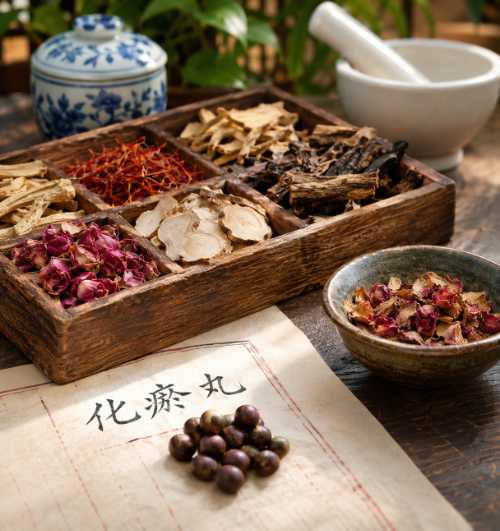
A recent study published in Frontiers in Immunology examined Huàyū Wán (化瘀丸), a traditional Chinese medicine formula, and its potential effects on chemotherapy-resistant esophageal cancer. The findings are encouraging, although the research remains at an early experimental stage.
When Cancer Cells Resist Treatment
Esophageal squamous cell carcinoma is a common form of esophageal cancer, particularly in parts of Asia. One of the drugs used to treat it is cisplatin, a chemotherapy medication that damages cancer cells and interferes with their ability to reproduce.
Unfortunately, some cancer cells develop resistance to cisplatin, allowing tumors to continue growing despite treatment.
Researchers at Shaoxing University in China investigated whether Huayu Wan might help overcome this resistance. The formula contains 15 herbal ingredients derived from two traditional prescriptions, Táohóng Sìwù Tāng (桃红四物汤) and Dǐdāng Tāng (抵当汤). These prescriptions have historical associations with addressing blood stasis and related conditions in traditional Chinese medicine.
Although Huayu Wan has been used in Chinese clinical settings, its effects on cancer cells and the biological mechanisms involved are not yet fully understood.
A Different Way of Destroying Cancer Cells
The researchers exposed human and mouse esophageal cancer cells that had developed resistance to cisplatin to different concentrations of Huayu Wan.
They found that the formula suppressed cancer cell growth, with stronger effects at higher concentrations and longer exposure times.
More importantly, the experiments identified a possible mechanism involving ferroptosis, a form of cell death driven by iron-dependent oxidative damage.
Normally, cells possess antioxidant systems that protect their membranes from damage. Cancer cells can exploit these defenses to survive stressful conditions, including chemotherapy.
Huayu Wan appeared to interfere with these protective mechanisms by reducing the effectiveness of glutathione-related antioxidant defenses while increasing the availability of iron within cancer cells. Together, these changes promoted damage to cell membranes and contributed to cell death.
This finding is significant because ferroptosis differs from some other forms of cell death targeted by conventional cancer treatments. Researchers are increasingly interested in whether activating this process could help overcome certain types of treatment resistance.
Encouraging Results, but Important Limitations
The investigators also conducted experiments in mice implanted with chemotherapy-resistant esophageal cancer cells. Animals treated with Huayu Wan developed smaller tumors than untreated animals.
Further examination revealed increased numbers of CD8-positive T cells, immune cells that can help recognize and destroy cancer cells. When the herbal formula was combined with an experimental anti-PD-1 immunotherapy, tumor suppression was greater than with either treatment alone.
These findings suggest that Huayu Wan may influence both cancer cell survival and aspects of the immune response.
However, laboratory and animal experiments cannot establish whether the same benefits would occur in people. Researchers must still determine which ingredients are responsible for the effects, whether the formula can be administered safely, and how it might interact with existing cancer treatments.
Traditional Knowledge Meets Modern Research
The study illustrates an interesting direction in medical research. Traditional herbal formulas contain numerous biologically active compounds, and modern laboratory techniques allow scientists to investigate how those compounds interact with cells and molecular pathways.
That does not mean traditional use establishes effectiveness against cancer. It means historical formulas may provide useful starting points for carefully controlled scientific investigation.
For now, Huayu Wan should be regarded as an experimental research candidate, not a proven cancer treatment or substitute for prescribed chemotherapy.
Nevertheless, the findings offer a promising direction for future investigation into one of oncology's most difficult problems: helping treatments remain effective when cancer cells learn to resist them.
Source: Research published in Frontiers in Immunology, 2026, examining Huayu Wan, ferroptosis, and cisplatin-resistant esophageal squamous cell carcinoma. Secondary report: Peter Dockrill, ScienceAlert, “Traditional Chinese Medicine Formula Kills Drug-Resistant Cancer Cells in The Lab.”
