

Between Heaven and Earth:
The Human Place in Chinese Medicine
One of the most beautiful ideas in Chinese medicine is the relationship between Heaven, Earth, and Human, or Tiān-Dì-Rén (天地人). At first, this may sound poetic or philosophical, but it is also very practical. It reminds us that human health is not separate from nature. The body lives between sky and ground, season and climate, food and breath, activity and rest.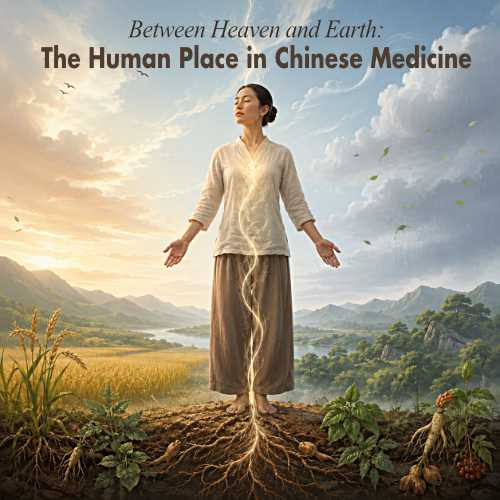
Traditional Chinese Medicine does not see the human body as an isolated machine. It sees the person as part of a larger pattern. Weather affects the body. Seasons affect energy. Food affects mood and strength. Sleep, emotion, work, movement, and environment all influence health. A person is not simply “well” or “sick” inside the body alone. Health is shaped by relationship.
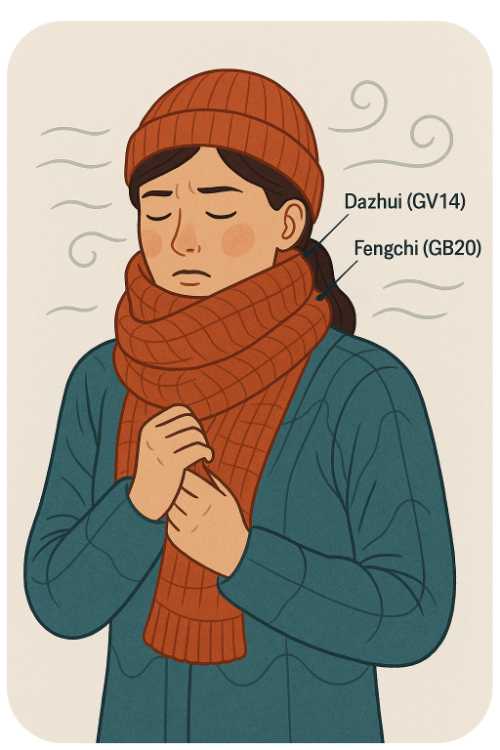
In this view, “Heaven” does not only mean something religious. It can refer to the sky, climate, time, and the great rhythms of nature. The rising and setting of the sun, the change from spring to summer, the arrival of cold wind or summer heat, all belong to Heaven. These changes are not background details. They are active forces that influence the body.
For example, many people feel different in winter than in summer. Appetite changes. Sleep changes. Skin, breathing, mood, and energy may all shift with the season. Chinese medicine pays close attention to these changes. It asks how the person is responding to the time of year, the climate, and the pattern of life.
“Earth” refers to the ground beneath us and the material support that sustains life. Food comes from Earth. Water comes through Earth. Herbs, grains, roots, fruits, and minerals all arise from the earth. In Chinese medicine, digestion and nourishment are central to health because the body must continually transform what it receives from the world.
This is one reason food therapy has always been important in Chinese health culture. Food is not only measured by calories, protein, or vitamins. It is also understood by its qualities: warming or cooling, moistening or drying, light or heavy, easy or difficult to digest. These qualities are considered in relation to the person, the season, and the condition being treated.
The third part is “Human.” This is where the idea becomes especially important. Human beings are not passive objects controlled by Heaven and Earth. We respond. We adapt. We make choices. We can live in a way that supports balance, or we can ignore the conditions around us until the body begins to complain.
This is the heart of yǎngshēng (養生), often translated as “nourishing life.” Yangsheng is not simply a collection of health tips. It is the practice of living with better awareness of relationship. How much should we rest? What foods are appropriate for this season? Are we moving enough? Are we overworking? Are we holding emotional tension? Are we living against the natural rhythm of the day?
Chinese medicine often asks a different question than modern medicine. Modern medicine may ask, “What is the disease?” Chinese medicine also asks, “What pattern has become disturbed?” That pattern may include the organs, but it may also include the weather, diet, emotional life, sleep, age, constitution, and season.
This does not make Chinese medicine vague. It makes it relational. A headache may not be understood only as pain in the head. It may be related to stress, Liver Qi constraint, lack of sleep, rising heat, cold wind, poor digestion, or several factors together. The symptom is important, but the relationship behind the symptom is also important.
Spending time in nature can make this easier to understand. In a quiet natural setting, we may notice the body more clearly. Breath slows. The eyes relax. The nervous system settles. We feel temperature, wind, light, smell, sound, and ground. The body remembers that it belongs to a living world.
The relationship between Heaven, Earth, and Human is not an old idea with no modern value. It may be more relevant now than ever. Many people live indoors, under artificial light, with irregular sleep, constant stimulation, processed food, and little contact with natural rhythms. Chinese medicine offers a different reminder: health is not only something we fix after it breaks. It is something we cultivate through daily relationship.
To nourish life is to learn where we stand. Above us is Heaven: time, climate, light, and season. Beneath us is Earth: food, water, ground, and support. Between them is the human being, breathing, sensing, adapting, and learning how to live with greater harmony.
2026 Qi Journal