Why Do Some People Practice
Taijiquan for Life?
Getting people to begin exercising is one challenge. Getting them to continue may be the more important one.
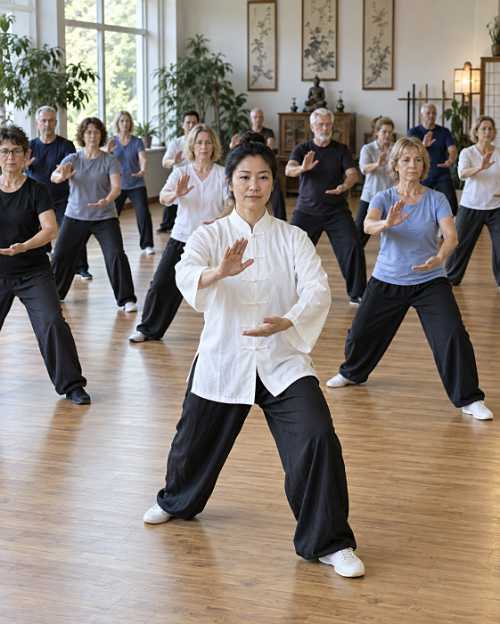 A new study published in Frontiers in Psychology examined what helps older adults maintain a long-term Taijiquan practice. Although the study was small, involving only 16 participants, its findings touch on something familiar to many experienced Taijiquan and Qigong practitioners: these arts can gradually become more than exercise. They become part of how a person lives.
Researchers interviewed four groups in Jiaozuo, China: Taijiquan practitioners, instructors, researchers, and administrators, with four people in each group. Rather than testing whether Taijiquan improves a particular health condition, the researchers were interested in “exercise commitment,” or what encourages someone to keep practicing after the initial enthusiasm has passed.
The interviews identified five broad areas that may support continued participation: the content of the practice itself; verbal encouragement and self-guidance; support from instructors; encouragement and interaction among fellow practitioners; and some form of monitoring or recording progress.
None of these findings is particularly surprising by itself. Together, however, they help explain why a successful Taijiquan class can become something quite different from a typical short-term exercise program.
People may initially enroll because they want better balance, less stiffness, stress reduction, companionship, or simply a new form of exercise. If practice continues, however, the motivation can change. Students begin recognizing movements they could not perform comfortably several months earlier. Balance improves. The form becomes more familiar. New details become apparent within movements they thought they already knew. Practice itself can become satisfying rather than merely a means of reaching a health goal.
The social environment also matters. A knowledgeable and supportive instructor can provide correction without making beginners feel unsuccessful. Fellow students provide encouragement, shared experience, and a reason to return. The researchers found that external structure, including attendance records, reminders, recognition of regular participation, and simple progress monitoring, may also help, provided it remains supportive rather than coercive.
This distinction is important. Long-term practice is unlikely to develop simply because students are told they “should” exercise. The researchers distinguish between internal desire to continue and external reasons for maintaining participation. Both can influence behavior, but enjoyment, satisfaction, personal investment, social support, and opportunities to participate appear important in turning an activity into a lasting habit.
Taijiquan and Qigong may have an advantage in this respect because there is no obvious point at which the practice is finished. Learning the choreography is only an early stage. As familiarity develops, attention can shift toward balance, alignment, breathing, relaxation, coordination, intention, and increasingly subtle qualities of movement. A practice that once required considerable concentration can eventually become part of the rhythm of daily life.
This may place traditional Chinese exercise in a somewhat different category from workout programs built primarily around repetitions, calories, distance, or increasing resistance. Those approaches can certainly become lifelong practices as well. But Taijiquan and Qigong traditionally combine physical training with attention, self-regulation, and gradual refinement. For some practitioners, the reason they continue after many years is no longer the same reason they started.
The researchers caution that their study is exploratory. Sixteen carefully selected participants from one Chinese city cannot represent all older adults or prove that the proposed strategies will improve retention. The next step is to develop and test programs based on the framework in larger and more varied populations.
Still, the study asks an important question. The health benefits of an exercise are of limited value if people stop doing it after several weeks.
For teachers, perhaps the lesson is that attracting new students is only the beginning. Good instruction should also give them reasons to return: achievable progress, interesting material, supportive classmates, personal attention, and the sense that there is always something more to discover.
The best exercise may not simply be the one shown to provide benefits in a clinical trial. It may be the one a person is still practicing years later.
Reference: Sun X, Arsapakdee K, Choosakul C. “Developing a Taijiquan exercise pattern for Chinese older adults: a qualitative study based on the exercise commitment model.” Frontiers in Psychology. Published September 7, 2026.